Most meme assets compete for attention first and explain utility later. Flokicoin is more interesting because it tries to move in the opposite direction: keep the meme energy, but attach it to a coin, a chain, a wallet, node infrastructure, and apps people can actually use.
What to know
- FLC is a native coin, not just a token issued on another network.
- Lokichain gives the project its own base layer, with Scrypt Proof of Work and described AuxPoW support.
- Tap Wallet makes the network visible, giving users a place to hold, send, receive, test, and understand FLC. Tap Codes enable on-chain faucet claims, and Tap Days are community events where miners and holders fund the faucet for new users.
- Lightning, Lokinode, and Lokihub extend the story beyond branding, toward payments, routing, and operator infrastructure.
- Web Of Fun gives the ecosystem a cultural layer, so the project does not become pure backend with a mascot attached.
- FLOKI is the useful contrast: a large meme token on Ethereum and Binance Smart Chain, while Flokicoin is positioning FLC as the base coin of its own network.
The Meme Is Only the Opening Scene
A mascot can bring people in, but it cannot carry the whole product forever. That is the useful way to read Flokicoin: not as a joke trying to become serious overnight, but as a playful crypto project trying to avoid the usual meme-coin dead end where the product is mostly a ticker, a chart, and a community slogan.
The important word is use. FLC is positioned as something people can mine, move, test in a wallet, route through infrastructure, and connect to an ecosystem. That gives the project a wider surface area than a token campaign built only around attention cycles. It also gives readers a better standard for judging the project: not whether the meme is loud, but whether the infrastructure becomes useful enough to make the meme matter.
Flokicoin is strongest when it shows that a meme can have rails beneath it.
That framing is important because it keeps the article grounded. Flokicoin does not need to be presented as larger than it is. The stronger argument is more precise: compared with many meme assets, it gives people more to inspect than branding alone.
A Coin With Its Own Ground Underneath
Most meme tokens rent space. They are issued on an existing chain, pushed into liquidity pools, and carried by infrastructure they do not control. That model can move quickly, but it also makes the asset feel thin: settlement, fees, security, wallets, explorers, and developer assumptions all come from somewhere else.
That is where FLOKI becomes a useful contrast. FLOKI may have a much larger brand, but structurally it is still a token issued on Ethereum and Binance Smart Chain. Its network life depends on external rails. That is not automatically bad, but it does shape what the asset is: a meme token operating inside someone else’s base layer.
FLC takes a different position. It belongs to Lokichain, which means the coin sits at the base of its own network. That gives Flokicoin a cleaner crypto-native argument: blocks, mining, nodes, wallet flow, and infrastructure are not borrowed scenery; they are part of the project’s own stack.
This is why the comparison should not be reduced to two tickers. One side is a token experience. The other is trying to become a coin experience. The difference matters because native coins have to carry more responsibility: they need users, miners, operators, software, documentation, and a reason for the network to keep moving.
Backed by Mining, Not Just Printed Attention
The cleanest technical argument for FLC is Proof of Work. Lokichain uses Scrypt Proof of Work, and the project describes merged mining through AuxPoW. In practical terms, that gives the coin a more traditional crypto foundation than assets created entirely inside token contracts.
That matters because mining changes the texture of the asset. A mined coin is linked to work, machines, external cost, and block production. It does not feel like a balance printed into existence inside a contract. It feels closer to the older crypto idea: open participation, measurable effort, and a network that has to be maintained rather than merely marketed.
This is also where the FLOKI comparison becomes sharpest. FLOKI is a token on other networks. FLC is presented as a mined coin with its own chain logic. For users who still care about the difference between a coin and a token, that distinction is not cosmetic. It changes what the project has to prove.
A token can borrow a chain. A mined coin has to carry its own chain.
FLC also keeps the monetary message simple: zero transaction tax and one-minute block production. Those claims do not make the project successful by themselves, but they do make its intention clearer. This is not only scarcity theater or meme energy; it is a coin being framed for circulation.
Tap Wallet Makes the Network Feel Real
Infrastructure becomes easier to understand when people can open an app and touch it. That is the role of Tap Wallet. It turns FLC from an abstract coin into a visible product: balance, send, receive, faucet, settings, and a transaction feed in one place. Tap Wallet is a lightweight, mobile-first PWA that runs directly in the browser or as a Mini App inside Discord and Telegram — no App Store installation required.
A wallet is not a small detail for a young coin. It is the front door of the network. If that first experience feels clean, people are more likely to test the coin, send it, receive it, and understand why a native chain matters. If it feels confusing, even good infrastructure can remain invisible. Anyone can start from the Tap Wallet onboarding and be holding FLC within minutes.
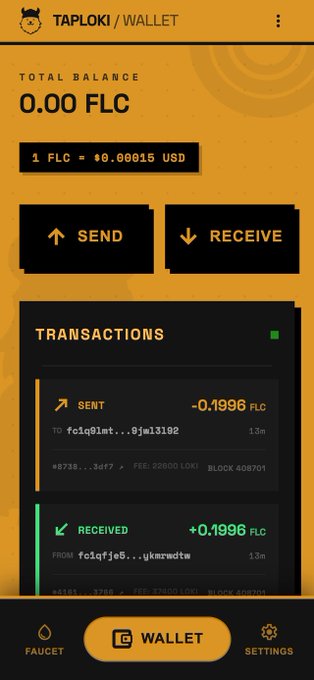
Tap Wallet gives FLC a simple consumer layer: open, send, receive, and learn by using.
The visual identity also helps. Tap Wallet does not look like another sterile crypto dashboard. It keeps the Flokicoin personality while making the product feel direct and usable. That balance matters because meme projects often face a design trap: become too technical and lose the audience, or stay too playful and never earn trust.
Tap Codes: Enter a Code, Receive Real FLC
Tap Codes are unique bearer codes in the format TAP-XXXXXXXXXX. During community events, these codes are dropped in Discord and Telegram. A user enters a Tap Code inside Tap Wallet and receives real FLC on-chain — no sign-up, no KYC, no friction. It is a simple mechanic with an important function: it turns the wallet into a faucet terminal that makes first contact with the network feel immediate and tangible.
Tap Days: Community-Funded Faucet Events
Tap Days are community events where miners and holders fund the faucet so new users can experience the Flokicoin network firsthand. During these events, limited-time Tap Codes are dropped exclusively in the project's Discord and Telegram communities. The model solves a real problem for young coins: distribution. Instead of relying on exchange listings or airdrops controlled by a central team, Tap Days let the community itself decide when and how new users receive their first FLC. That makes onboarding feel grassroots rather than corporate.
Together, these features show that Taploki is not just a wallet in the traditional sense. It is the consumer-facing hub of the Flokicoin ecosystem: onboarding, faucet distribution, and cross-platform access in one place. Users can link their Flokicoin address to Discord or Telegram and keep their FLC synced across devices. That is where Flokicoin can make the abstract concrete. Tap Wallet is not just a supporting app; it is the place where the project's claim becomes testable.
Lightning, Lokinode, and Lokihub Add the Rails
The next layer is infrastructure. Lightning support gives Flokicoin a sharper payment narrative, pointing toward speed, routing, and a user experience that can feel closer to everyday transfers than slow on-chain waiting. For a coin that wants to be used rather than only held, that matters.
Lokinode and Lokihub add another dimension. They make the project less dependent on passive holders and more oriented toward operators, builders, and people who want to run parts of the network themselves. That is a healthier direction than building a brand where everyone watches the same chart and waits for someone else to create momentum.
This is where Flokicoin becomes more than a mascot. A coin with wallet software is useful. A coin with wallet software, node infrastructure, Lightning support, documentation, and apps starts to look like an ecosystem. The project still has to prove adoption, reliability, and developer interest, but the foundation is broader than the average meme launch.

Lightning support gives Flokicoin a clearer payment angle beyond simple holding.
Web Of Fun Gives the Ecosystem a Personality
Infrastructure gives Flokicoin credibility, but it should not make the project feel cold. That is where Web Of Fun, or WoF, fits the story. It gives the ecosystem a lighter app layer, connecting the coin to playful services, community interaction, and broader internet-native use.
This part matters because adoption is rarely driven by infrastructure alone. People need reasons to return: spaces, tools, rituals, games, social loops, and simple actions that make the coin feel present in daily internet behavior. A chain can be technically interesting and still feel empty if there is nothing to do with it.
WoF helps Flokicoin keep its cultural edge while still building around real network components. In editorial terms, it is the bridge between meme energy and product habit. That bridge is important because the project’s strongest identity is not pure seriousness; it is seriousness made approachable.
NonKYC Adds a Market Doorway
Access matters too. FLC is listed on NonKYC through the FLC/USDT market. For a smaller Proof of Work coin, that gives interested users a clearer market route without turning the article into a price discussion.
The point is not to promise liquidity, performance, or future demand. The point is simpler: discovery becomes easier when the coin has a visible market, a website, documentation, and a wallet path all pointing in the same direction. Those pieces do not guarantee traction, but they reduce friction for people who want to inspect the project seriously.
The FLC/USDT market is available on NonKYC.
The Cleaner Comparison
The strongest comparison is not a checklist. It is a question of depth. FLOKI is a token with meme distribution. It lives on Ethereum and Binance Smart Chain, which means its foundation comes from external networks. That makes it easy to understand, but also easy to categorize: it is a printed token on someone else’s rails.
Flokicoin is building from the other side. FLC has its own chain, its own Proof of Work base, its own wallet direction, its own node story, and its own ecosystem language through WoF. That gives the project more dimensions than the usual meme asset, but it also raises the bar. A native coin cannot hide behind branding forever; it has to make the network useful.
That does not make FLC automatically bigger, safer, or more valuable. It does make it more interesting from a crypto-native perspective. There is more to inspect than branding, and there are more moving parts to evaluate: chain design, mining, wallet quality, node participation, documentation, market access, and whether users find reasons to come back.
For readers tired of meme tokens that end at marketing, Flokicoin offers a different proposition: keep the fun, but add the backend. The editorial case is strongest when it stays there, with practical infrastructure as the evidence instead of hype as the argument.
Looking Ahead
Flokicoin’s next challenge is communication as much as engineering. The ingredients are already legible: FLC is native to Lokichain, Scrypt Proof of Work gives it a mined foundation, Tap Wallet makes the coin usable, Lightning support gives it a payments angle, and Lokinode, Lokihub, and WoF give the ecosystem a technical and cultural spine.
The project now has to keep turning those ingredients into simple user journeys. Can someone understand the coin quickly? Can they get a wallet, receive FLC, send it, explore the chain, read the docs, and see why the network exists? If the answer becomes yes, Flokicoin has a clearer story than most meme assets: not another token chasing attention, but a meme-shaped coin trying to build enough rails to deserve it.